AI in Leadership: What Leaders Must Do Today
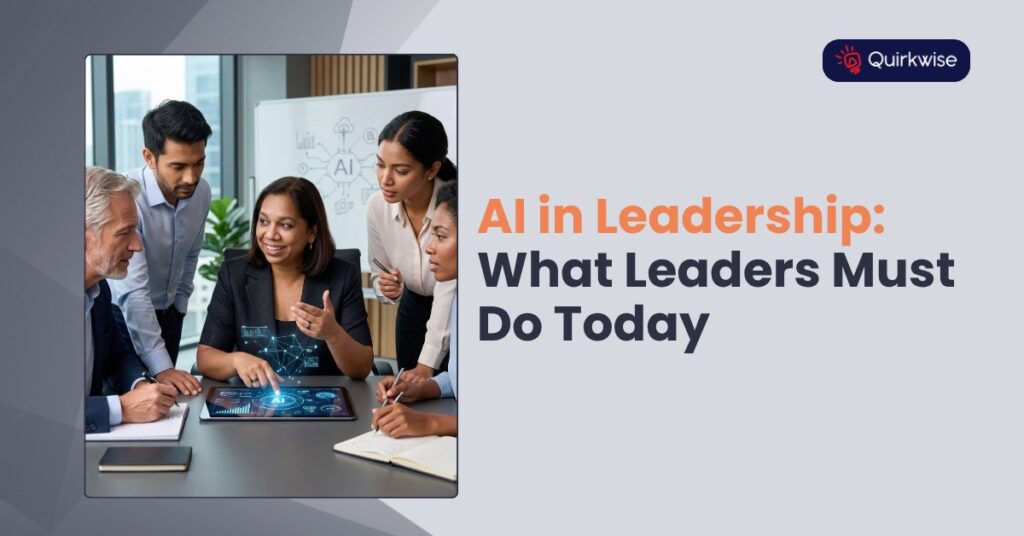
What Is AI in Leadership and Why It Matters Leadership has always been about making decisions under uncertainty. What is changing is the volume, speed, and complexity of the information leaders must process before they decide. AI enters here not as a curiosity, but as a structural shift in how organisations operate.   Artificial intelligence in leadership refers to the deliberate use of AI tools and systems to support how leaders think, decide, communicate, and manage their teams. This includes everything from predictive analytics and automated reporting to performance tracking and AI-assisted hiring. In short, it is the integration of machine intelligence into the practice of leading people and organisations.   For most of the past century, leadership relied heavily on intuition built from experience. That intuition is not going away. However, it is increasingly expected to sit alongside evidence. Leaders who once operated on gut feel and pattern recognition are now being asked to make sense of real-time data, model multiple scenarios simultaneously, and explain their decisions to a wider set of stakeholders. AI makes this possible. It also makes the gap between leaders who engage with it and those who do not significantly wider.   The numbers support this urgency. Worker access to AI rose by 50% in 2025, and the number of companies with 40% or more of their AI projects in production is set to double within six months, according to Deloitte’s State of AI in the Enterprise 2026 report. Almost three-quarters of CEOs are now their organisation’s main decision-maker on AI strategy, and companies expect to double AI spending in 2026, up from an average of 0.8% of revenue to approximately 1.7%, according to BCG research.   This is not a distant scenario. It is the operating environment leaders are working in right now.   👉 Want to sharpen how you think and decide under pressure? Read our piece on decision-making skills for leaders.   How AI in Leadership Is Transforming Decision Making   Data-Driven Thinking in AI in Leadership Decision-making has historically been constrained by the pace at which information could be gathered, verified, and interpreted. AI removes much of that constraint. Leaders can now access dashboards that synthesise sales data, customer sentiment, supply chain performance, and financial projections in real time. Predictive analytics can surface patterns that no individual analyst would catch as quickly.   By the end of 2025, nearly 70% of global organizations were deploying AI in at least one business function, with data quality and governance emerging as clear competitive differentiators as AI moved deeper into daily operations.   McKinsey’s research makes the stakes concrete: if organizations redesign their workflows around AI agents rather than simply automating isolated tasks, AI could add approximately $2.9 trillion per year to the US economy by 2030. The difference between those two approaches, layering AI onto existing processes versus rethinking those processes entirely is a leadership call, not a technology call.   That said, not all AI-informed decisions are good ones. A 2025 SAP study found 55% of executives say AI insights routinely replace or bypass traditional decision-making in their firms. When leaders outsource judgment entirely to a system they do not fully understand, the accountability gap becomes a liability. AI can generate the analysis. The decision still belongs to the human in the room.   Reducing Bias with AI in Leadership One of the more persuasive arguments for AI in decision-making is its potential to reduce human bias. Behavioral research has documented for decades the ways in which anchoring, recency bias, affinity bias, and confirmation bias distort leadership decisions — particularly in hiring, promotion, and performance evaluation. An AI system, designed well, does not carry those prejudices.   However, this is also where AI carries its own specific risks. While AI is not inherently biased, it learns biases that can cause employers to make decisions that expose them to legal and reputational risks. AI algorithms are trained on large datasets, and if those datasets are biased, AI systems can perpetuate or even exacerbate discriminatory practices. The implication is not that AI should be avoided in high-stakes decisions, but that its outputs require human interpretation. A leader who can read an AI recommendation critically — who understands what data the system was trained on, and what its limitations are — is meaningfully different from one who treats the recommendation as final. For deeper research on this intersection, the AI and decision-making research at HBR is worth reading carefully.   How AI in Leadership Is Changing Team Management   Automation and Productivity in AI in Leadership The first wave of AI in team management is visible in task automation. Scheduling, status reporting, routine data entry, first-pass document review, customer query triage, these activities are being handed to AI systems at speed. In 2023, McKinsey research found that only 30% of employees reported using AI at work. By 2025, that figure had reached 76%.   The productivity gains are real, but the organizational consequences are complex. According to data compiled by eWeek and Challenger, Gray & Christmas, over 52,000 tech sector jobs were cut in the first three months of 2026, with the driving force behind the majority of these cuts being companies redirecting budgets toward AI infrastructure and AI-assisted workflows.   The companies managing this responsibly are making a harder, slower choice. When leaders avoid redefining roles early, they create a moment where layoffs feel unavoidable. Teams wake up with hundreds of people whose old jobs no longer exist and no clear plan for what comes next. At that point, layoffs become a reaction to inaction. That is a failure of leadership, not a consequence of AI.   Block’s CEO, Jack Dorsey, offered the bluntest version of this emerging reality in March 2026, when his company reduced its workforce from approximately 10,000 to fewer than 6,000. In a company-wide memo shared publicly, Dorsey wrote: “This is not driven by financial difficulty, but by the growing capability of AI tools to perform a wider range… Continue reading AI in Leadership: What Leaders Must Do Today

First Time Manager Guide: How to Lead a Team Successfully
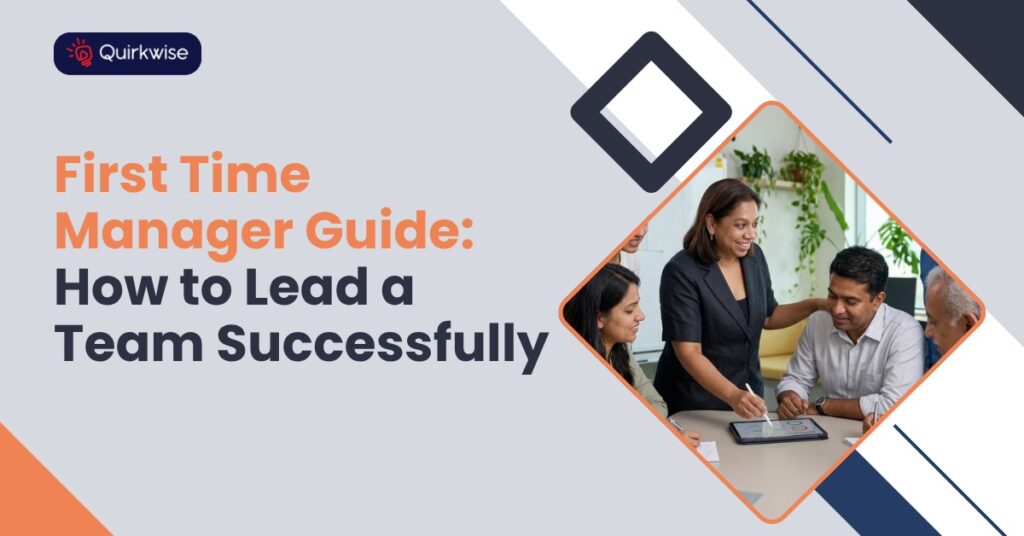
What Is a First Time Manager Guide and Why It Matters   As a first-time manager, the first few weeks in a management role have a specific texture that nobody warns you about. You sit in your first team meeting as the manager, and you are not sure what register to speak in. You wonder whether to lead or listen. You second-guess things you would have said without thinking a month ago. The promotion felt like recognition. The first week feels like starting over.   That disorientation is normal. It is also a signal that the role is genuinely different, not just a bigger version of what you did before. You are no longer measured by what you produce on your own. You are measured by what your team produces.   According to Gallup research, 82% of the time, organisations fail to select managers with the right talent for the role. A significant part of that failure traces back to the fact that high performers are promoted into leadership without being prepared for what it actually requires.   This first-time manager guide is for people in that gap. It will not hand you a personality transplant. It will give you specific things to think about, specific things to do, and specific mistakes to avoid. The skills that made you good at your previous role will not automatically make you a good manager. Technical expertise matters less than it did. Leadership mindset strategies matter more. The earlier you accept that, the faster you close the gap.   First Time Manager Guide to Building Leadership Skills   Communication Is Your Most Important Tool People cannot work well with a manager they cannot read. If your team is guessing what you want, what success looks like, or whether they have done a good job, that is a communication failure, and it is your job to fix it.   Set expectations clearly. When you assign work, say what a good outcome looks like. Not just the task, but the standard. “Write a report” is different from “Write a two-page summary that a non-technical reader can understand, ready by Thursday.” The second version removes ambiguity. Ambiguity costs time and morale.   Listen before you respond. One of the most common problems for new managers is talking too much. You feel pressure to have answers, to demonstrate competence, to justify the promotion. The instinct is understandable. It is also counterproductive. Your team has information you do not have. If you speak first, you get less of it. Listen. Ask questions. Let people finish their thoughts.   Create feedback loops. Your team needs to know what they are doing well and where they need to adjust. This does not have to be formal. A short conversation after a presentation, a note after a difficult client call, a quick check-in when something went sideways. Regular, specific feedback is more useful than an annual review that covers twelve months in one hour.   Communication is also two-way. Ask for feedback on your own management. It signals that you are serious about improving, and it often surfaces things you would not have noticed on your own.   Decision Making New managers often get stuck in one of two traps. Either they overthink every decision and cause delays, or they rush through decisions to appear decisive and make errors. Neither approach serves the team.   Most decisions that come to a manager are not as complex as they feel. A useful starting point is to ask: what is the cost of getting this wrong? If the cost is low and reversible, make the call and move on. If the cost is high or irreversible, slow down and gather more information before deciding.   There are structured approaches to decision-making that can help when the stakes are higher. The HBR Decision Making Frameworks library at hbr.org covers several that are practical and well-tested. You do not need to master all of them. Pick one or two that suit how you think and use them consistently.   What matters most is building the habit of reflection after decisions. Not self-criticism, but honest review. What did you know? What did you not know? What would you do differently? Over time, that review process builds judgment. Judgment is what separates experienced managers from new ones, and there is no shortcut to it except practice.   First Time Manager Guide to Leading a Team Effectively   Set Clear Goals and Expectations A team without clear goals spends energy on the wrong things. People work hard but not necessarily on what matters. One of your first jobs as a manager is to make sure everyone on your team knows what they are responsible for and what success looks like.   Define roles clearly. Not just job titles, but who owns what. When two people think they are both responsible for something, it usually means neither treats it as their primary responsibility. When something belongs to no one, it does not get done. Be specific about ownership.   Connect individual work to the larger goal. People work better when they understand why their work matters. When you assign something, explain where it fits. That context changes how seriously people take it.   Build Trust and Accountability Trust is built through small, repeated actions, not declarations. The most reliable ones are: doing what you said you would do, being honest about what you do not know, and not burdening your team with problems that are not theirs to carry.   Start with the practical. Before your next one-on-one, write down one commitment you have made to each person on your team. Have you followed through? If not, address it directly before the meeting. That single habit, done consistently, builds more credibility than any speech about trust.   Transparency does not mean sharing everything. It means not hiding things your team needs to know. If a deadline is moving, tell them early. If the business is in a difficult… Continue reading First Time Manager Guide: How to Lead a Team Successfully