
There are, at last count, more leadership frameworks than there are functioning democracies. This is not hyperbole. This is a fact.
Let us take stock. We have the ABCs of Leadership. The 5Cs. The 7Cs. The 8Cs, for those who felt seven was not enough. We have James MacGregor Burns giving us Transformational Leadership in 1978, which is important and real and widely cited and almost universally misapplied. We have Robert Greenleaf’s Servant Leadership, adopted enthusiastically by organisations that continue to treat their employees like indentured help. We have Situational Leadership from Hersey and Blanchard, which asks leaders to read the room, a skill that turns out to be surprisingly rare despite being the entire premise of the framework.
Take a deep breath, because there is more.
We have Adaptive Leadership from Heifetz and Linsky, which is genuinely sophisticated and therefore the least used. We have Authentic Leadership, Resonant Leadership, Distributed Leadership, and Quiet Leadership for introverts who were tired of being told to speak up, all of which are authentic in the sense that someone genuinely believed in them. We have John Maxwell’s 21 Irrefutable Laws, after which someone presumably sat down and wrote the 22nd. We have Jim Collins and his Level 5 Leaders, humble and ferociously determined, a combination so rare it required a decade of research to find eleven examples.
We also have Stephen Covey’s 7 Habits and Daniel Goleman’s emotional intelligence, without which no leadership development programme is considered complete and with which, apparently, the same outcomes obtain. And finally, we have the VUCA framework, and the BANI framework, Brittle, Anxious, Non-linear, Incomprehensible, which is also an accurate description of most leadership teams attempting to navigate the frameworks above.
BUT THE WORLD IS ON FIRE.
Not metaphorically. Gaza. Sudan. Ukraine. Myanmar. Climate change is in free fall. Democratic backsliding across four continents. Institutional collapse in places that built the institutions. Corporate leaders helming organisations through what they call “transformation” while their employees call it something unprintable. The UN Security Council, a body comprised entirely of nations whose leaders have presumably encountered at least one leadership book, has managed to veto its way into paralysis on most of the things that matter.
We are not short on knowledge. We are drowning in it. And yet.
The Publishing Industrial Complex
Here is what i think happened in the last decade. Books about leadership became the fastest-growing category in business publishing. Amazon’s self-publishing arm made it possible for anyone with a near-death experience or a moment of getting scalded by a coffee, a corporate restructuring, or podcast equipment to distill their insights into a leadership book. LinkedIn newsletters have since democratised the process further, reducing the barrier to entry from “must have survived a significant personal crucible” to “must have internet.” Every week, a new voice arrives to tell us what leadership really means, having spent between three seconds and fifity years learning it the hard way, or alternatively, having done a certification programme and found their niche.
None of this is entirely wrong. Some of it is genuinely useful. The problem is not that there is bad content in the ecosystem. The problem is that we have confused content production with capability development, and we have been doing it long enough that the confusion now feels like wisdom.
A framework describes good leadership the way a recipe describes a meal. The recipe is accurate. The recipe is well-researched. The recipe has photographs and testimonials and a foreword by someone credible. And yet no one has eaten. Reading about transformational leadership is not the same as developing the psychological maturity to transform anything, least of all yourself under pressure. Knowing that emotional intelligence exists is not the same as having it in the room where the decision is being made at eleven o’clock on a Wednesday night when everyone is exhausted and the stakes are real.
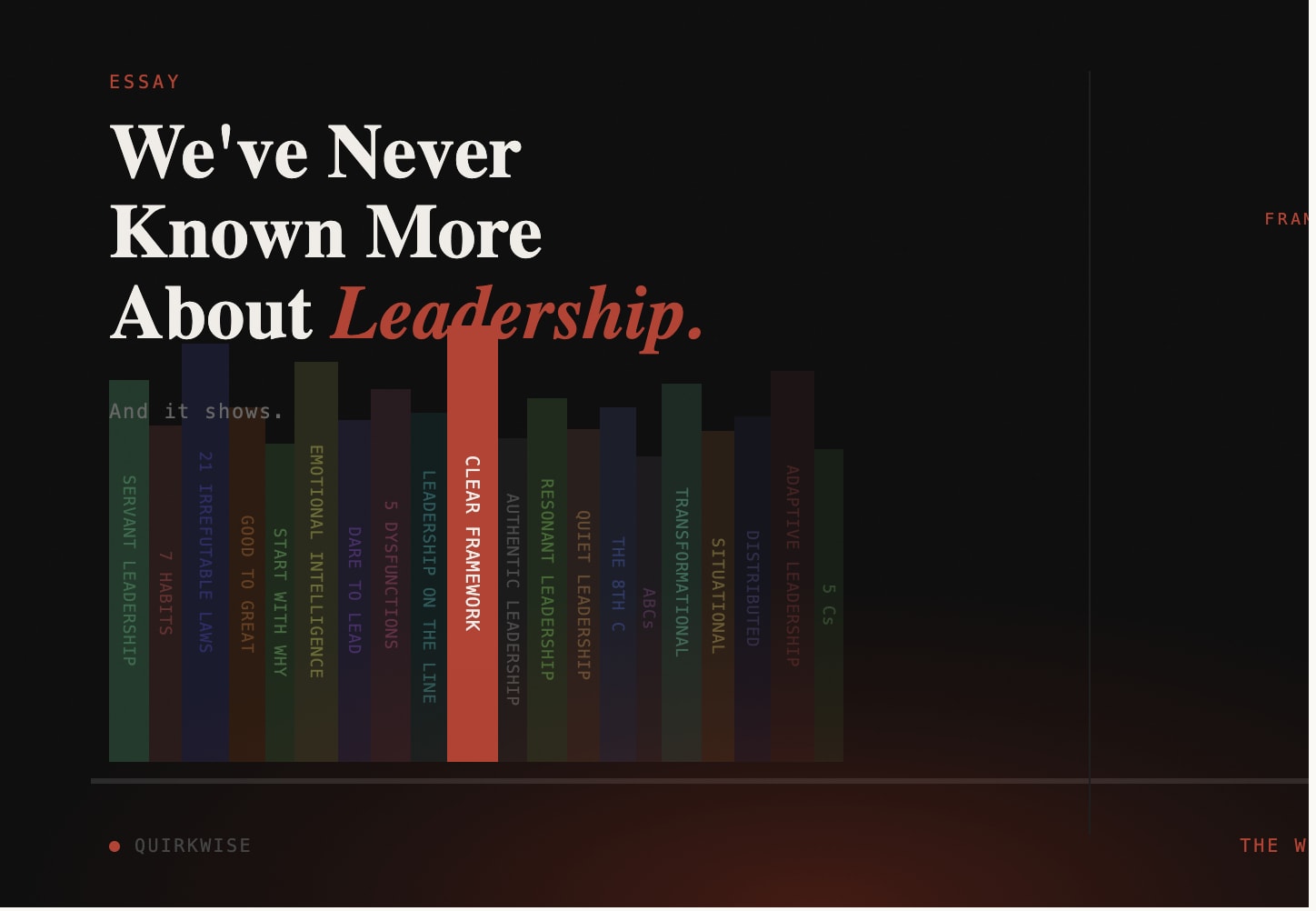
Introducing: The CLEAR Framework
In the spirit of contribution, and because this space clearly needed one more, we are proud to present the CLEAR Leadership Framework, developed over the course of this essay, fully proprietary, and available for licensing.
C stands for Clarity. Leaders must be clear. About what, exactly, varies by situation, but clarity is important. All frameworks agree on this. Clarity about vision, clarity about values, clarity about strategy.
L stands for Leverage. Not the financial kind. The human kind. Leaders must leverage their teams, their networks, their circumstances. Leverage is the difference between working hard and working smart. which is a distinction that sounds compelling until you try to explain it to someone who is already doing both and getting neither.
E stands for Empathy. This one is non-negotiable. Every framework published after 2010 contains empathy. It is the cross between quinoa salad and avocado toast of leadership competencies: widely prescribed, occasionally digested, inserted into things where it does not always belong, and considered morally superior regardless of outcome.
A stands for Agility. Leaders must pivot. Not the one made famous by Ross Geller in friends, but the real kind. They must be comfortable with ambiguity. They must hold uncertainty with grace, which is the kind of sentence that reads beautifully in a framework.
R stands for Resilience. Leaders must bounce back. They must model resilience for their teams. This is genuinely important. It is also, if we are being precise, the competency we invoke most often when we mean “we are not going to fix the structural conditions that require you to keep bouncing back, but we admire your form.”
CLEAR. Five competencies. One acronym. Suitable for keynotes, wallpaper, and the kind of team offsite where someone brings sticky notes and high ambitions. Available as a card deck by Q4.
The Real Problem, Stated Without a Framework
Here is what the hundreds of frameworks do not say, because frameworks are, by design, aspirational documents and aspirational documents are not in the business of saying difficult things plainly.
Most leadership content is written for and by the people who already want to lead well. It assumes a baseline of good faith, a reasonably functional psyche, and access to the kind of reflective space in which insight becomes behaviour change. It is, in other words, preaching to the converted while the unconverted are busy running things.
The leaders who most need the 21 Irrefutable Laws are the least likely to read them, and if they do, the most likely to read themselves as the protagonist rather than the cautionary tale. This is not cynicism. This is what psychologists call the self-serving bias, documented reliably since David Dunning and Justin Kruger’s 1999 paper, and yet conspicuously absent from the leadership competency models that followed.
There is also a structural problem that frameworks are not equipped to solve because frameworks operate at the level of the individual. They ask: what kind of leader are you, and how might you become better? This is a useful question. It is not, however, the question that explains why a well-credentialed, frequently-workshopped leader in a good organisation with a clear mandate still produces outcomes that range from mediocre to harmful. That question requires us to look at systems, incentives, board structures, shareholder pressures, political economies, and the gap between what organisations say they value and what they actually reward. None of these fit on a competency wheel.
Ronald Heifetz, who wrote Leadership on the Line with Marty Linsky, made this distinction carefully. Technical problems have known solutions and can be solved with existing expertise. Adaptive challenges require changes in values, beliefs, and behaviours, and they cannot be solved by applying a framework, no matter how elegant the acronym. Most of what is failing in leadership today is adaptive. Most of what we are selling is technical.
A Note on Coaches
The coaching profession has not been entirely blameless in this situation. The proliferation of coaching certifications, models, and methodologies has produced something of a paradox. There are now more people certified to facilitate change than there are organisations meaningfully changing. The ICF reports over 100,000 credentialed coaches worldwide. This is a real number. It is also a number that coexists peacefully with a world in which leadership dysfunction is not declining.
This is not an argument against coaching. It is an argument against the assumption that more coaches, more content, and more certification automatically produces better leadership in the wild. Coaching is effective when it reaches the right people at the right moment with the right quality of engagement. It is considerably less effective when it is a box ticked by an L&D function trying to demonstrate impact for a dashboard.
So What, Then
There is no tidy resolution here, and any essay on leadership that ends with five things you can do differently would be doing the exact thing it spent several hundred words criticising.
What I know is this. The knowledge exists. The frameworks are, many of them, good. The books contain real insight. The coaches, most of them, are trying. And leaders, most of them, are also trying, inside systems that make it very hard to do otherwise.
The gap is not informational. The gap is between a competency model and a human being who can hold complexity under pressure without reaching for the nearest comfortable distortion. That gap is not closed by a framework. It is closed, slowly and imperfectly, by experience, by honest feedback, by the kind of developmental relationships that are harder to scale and impossible to gamify, and by the willingness to be genuinely accountable to outcomes rather than to process.
The world is on fire. We have the reading list. The question is no longer what good leadership looks like.
The question is what it costs to actually become one, and whether we are willing to pay.
#Leadership #LeadershipDevelopment #OrganisationalDevelopment #SocialSector #CriticalThinking #ExecutiveCoaching #Quirkwise