
Nobody Tells You About the Silence After

Someone I loved is no more. I keep writing that sentence to see if it gets easier. It doesn’t. It just sits there, taking up more space than six words should. Their name has been in my phone for decades. I had a contact entry for them before I had one for anyone else. I knew their number by heart before phones made that unnecessary. And now I scroll past it sometimes, not on purpose, and my thumb hesitates for a second because some part of me hasn’t caught up yet. That part keeps almost calling. People say a lot of things when someone dies. They say they’re in a better place. They say time heals. They say at least you have the memories. They mean well. I know they mean well. But meaning well and being useful are two different things, and in the weeks after, I learned to nod at the right moments and let the sentences pass through me. What nobody said, not once, was: you will grieve alone in ways you didn’t expect. There is a term in bereavement research for what happens to adult siblings when a brother or sister dies. Researchers call it disenfranchised grief. Siblings are called, in the literature, forgotten mourners. The condolence calls go to the parents. The casseroles go to the spouse. The question everyone asks is how is your mother holding up and you stand there in your own house of grief with no one asking about the rooms inside it. The loneliness of sibling loss has a name. Knowing that helped me feel slightly less like I was losing my mind. It made me reach for my phone at 8 in the morning out of habit. We talked at odd hours. Before I was fully awake, my body would start the motion and then stop, every morning, which is its own small violence repeated on a schedule. It made the world continue. This is the part that no one warns you about. The world does not pause. The delivery person still rings the bell. The traffic outside still starts on time. My phone fills with messages about other things, normal things, things that have nothing to do with the fact that this person is gone. And I answer them, because what else do I do. I answer them in full sentences with punctuation and people think I are fine. I am back at work. I sit in calls and track what is being said and respond at the right moments. I file things. I meet deadlines. People think I am coping. I am not coping. I am just moving. There is an ice cream tub in the freezer that I cannot throw away. It has been there for six weeks. It is not about the ice cream. I just cannot do that particular thing yet. He loved mangoes. Every year, from around this time, we would start ordering them by the box. It was a whole thing. Comparing the ones from different places, arguing about which were better. This year the mangoes arrived in the market and I cannot look at them. I walk past the fruit cart and look at the ground. The vendor probably thinks I have something against fruit. I don’t. I just can’t do mangoes this year. I don’t know about next year. I haven’t turned the television on in the evenings. I don’t know exactly why. It feels like something I’m not allowed yet. Like I would be getting comfortable in a life that doesn’t have him in it, and I’m not ready to do that. We shared a history that no one else has. Not our parents. Not their friends. Not mine. There is a version of my childhood that only existed between us, a set of references and shorthand and running jokes that are now inaccessible. I am the only one left who remembers certain things. That is its own kind of weight. I am not trying to let go. I am trying to figure out how to carry this differently. Those are not the same thing, and I wish more people understood that. The guilt is specific and strange. I feel it when I have an ordinary morning. When I drink coffee and it is good coffee and I notice that it is good. When I am in a meeting and I am concentrating on the meeting. When an hour passes and I have not thought of them. Then I think of them. Then I feel the guilt of having not thought of them, which is its own loop, its own small cruelty. I feel it when something good happens. When I get work I wanted, or a conversation goes well, or I feel something close to fine. There is a voice underneath that says: you are not allowed this yet. I do not know whose voice it is. I do not know where that rule comes from. But it shows up reliably, and I have not yet found a way to argue with it. The loneliness of grief is not about being alone. I have people. I have people who love me and check on me and do not know what to say, which is the same as most of us. The loneliness is that the specific grief is mine. No one else lost exactly what I lost. My mother lost a child, which is a different loss, carried in a different body. Their friends lost them from one angle. I lost them from all of them. I lost the person who knew me before I was anyone in particular. Who remembered the version of me that existed before I became whatever I am now. They were my oldest witness. And witnesses cannot be replaced. Someone told me recently that I seemed to be handling it well. I smiled. I said something vague. I did not say that handling it well and actually being well are not the
We’ve Never Known More About Leadership. It Shows.
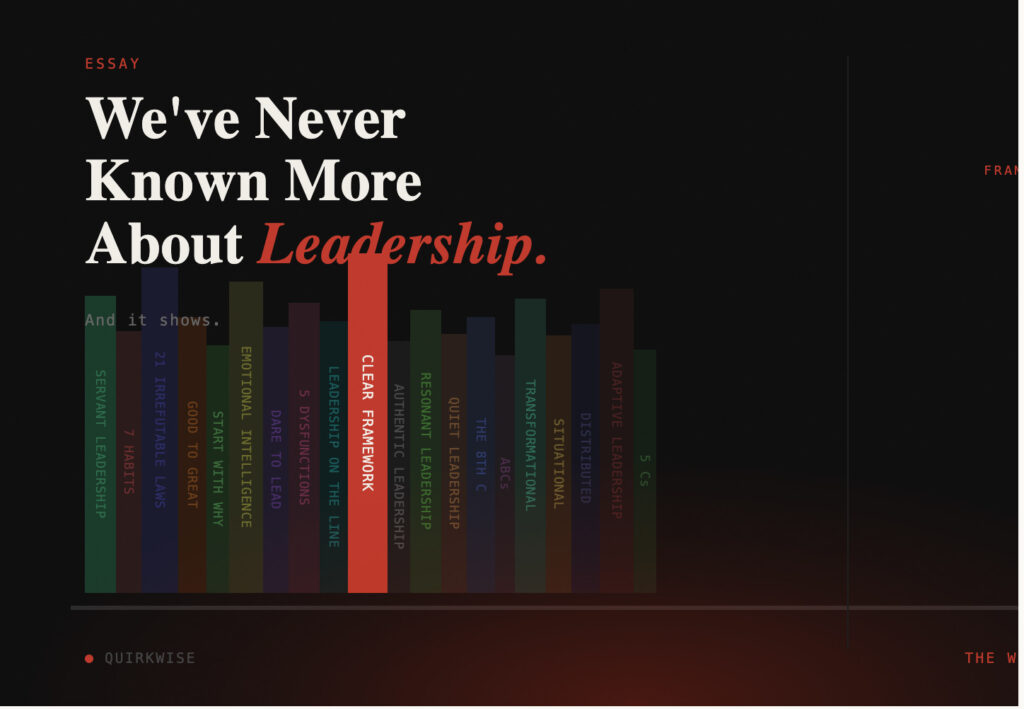
There are, at last count, more leadership frameworks than there are functioning democracies. This is not hyperbole. This is a fact. Let us take stock. We have the ABCs of Leadership. The 5Cs. The 7Cs. The 8Cs, for those who felt seven was not enough. We have James MacGregor Burns giving us Transformational Leadership in 1978, which is important and real and widely cited and almost universally misapplied. We have Robert Greenleaf’s Servant Leadership, adopted enthusiastically by organisations that continue to treat their employees like indentured help. We have Situational Leadership from Hersey and Blanchard, which asks leaders to read the room, a skill that turns out to be surprisingly rare despite being the entire premise of the framework. Take a deep breath, because there is more. We have Adaptive Leadership from Heifetz and Linsky, which is genuinely sophisticated and therefore the least used. We have Authentic Leadership, Resonant Leadership, Distributed Leadership, and Quiet Leadership for introverts who were tired of being told to speak up, all of which are authentic in the sense that someone genuinely believed in them. We have John Maxwell’s 21 Irrefutable Laws, after which someone presumably sat down and wrote the 22nd. We have Jim Collins and his Level 5 Leaders, humble and ferociously determined, a combination so rare it required a decade of research to find eleven examples. We also have Stephen Covey’s 7 Habits and Daniel Goleman’s emotional intelligence, without which no leadership development programme is considered complete and with which, apparently, the same outcomes obtain. And finally, we have the VUCA framework, and the BANI framework, Brittle, Anxious, Non-linear, Incomprehensible, which is also an accurate description of most leadership teams attempting to navigate the frameworks above. BUT THE WORLD IS ON FIRE. Not metaphorically. Gaza. Sudan. Ukraine. Myanmar. Climate change is in free fall. Democratic backsliding across four continents. Institutional collapse in places that built the institutions. Corporate leaders helming organisations through what they call “transformation” while their employees call it something unprintable. The UN Security Council, a body comprised entirely of nations whose leaders have presumably encountered at least one leadership book, has managed to veto its way into paralysis on most of the things that matter. We are not short on knowledge. We are drowning in it. And yet. The Publishing Industrial Complex Here is what i think happened in the last decade. Books about leadership became the fastest-growing category in business publishing. Amazon’s self-publishing arm made it possible for anyone with a near-death experience or a moment of getting scalded by a coffee, a corporate restructuring, or podcast equipment to distill their insights into a leadership book. LinkedIn newsletters have since democratised the process further, reducing the barrier to entry from “must have survived a significant personal crucible” to “must have internet.” Every week, a new voice arrives to tell us what leadership really means, having spent between three seconds and fifity years learning it the hard way, or alternatively, having done a certification programme and found their niche. None of this is entirely wrong. Some of it is genuinely useful. The problem is not that there is bad content in the ecosystem. The problem is that we have confused content production with capability development, and we have been doing it long enough that the confusion now feels like wisdom. A framework describes good leadership the way a recipe describes a meal. The recipe is accurate. The recipe is well-researched. The recipe has photographs and testimonials and a foreword by someone credible. And yet no one has eaten. Reading about transformational leadership is not the same as developing the psychological maturity to transform anything, least of all yourself under pressure. Knowing that emotional intelligence exists is not the same as having it in the room where the decision is being made at eleven o’clock on a Wednesday night when everyone is exhausted and the stakes are real. Introducing: The CLEAR Framework In the spirit of contribution, and because this space clearly needed one more, we are proud to present the CLEAR Leadership Framework, developed over the course of this essay, fully proprietary, and available for licensing. C stands for Clarity. Leaders must be clear. About what, exactly, varies by situation, but clarity is important. All frameworks agree on this. Clarity about vision, clarity about values, clarity about strategy. L stands for Leverage. Not the financial kind. The human kind. Leaders must leverage their teams, their networks, their circumstances. Leverage is the difference between working hard and working smart. which is a distinction that sounds compelling until you try to explain it to someone who is already doing both and getting neither. E stands for Empathy. This one is non-negotiable. Every framework published after 2010 contains empathy. It is the cross between quinoa salad and avocado toast of leadership competencies: widely prescribed, occasionally digested, inserted into things where it does not always belong, and considered morally superior regardless of outcome. A stands for Agility. Leaders must pivot. Not the one made famous by Ross Geller in friends, but the real kind. They must be comfortable with ambiguity. They must hold uncertainty with grace, which is the kind of sentence that reads beautifully in a framework. R stands for Resilience. Leaders must bounce back. They must model resilience for their teams. This is genuinely important. It is also, if we are being precise, the competency we invoke most often when we mean “we are not going to fix the structural conditions that require you to keep bouncing back, but we admire your form.” CLEAR. Five competencies. One acronym. Suitable for keynotes, wallpaper, and the kind of team offsite where someone brings sticky notes and high ambitions. Soon to be also available as a card deck. The Real Problem, Stated Without a Framework Here is what the hundreds of frameworks do not say, because frameworks are, by design, aspirational documents and aspirational documents are not in the business of saying difficult things plainly. Most leadership content is written for and by
The Invention of Female Self-Doubt

For a long time, I believed that the uneasy moments in my career came from something inside me. I told myself I was experiencing impostor syndrome, as if the doubt was a flaw in my personality that I needed to outgrow. It took me years to understand that my hesitation did not begin within me. It was shaped by the environments I learned to navigate and by the expectations I absorbed long before I entered any workplace. As a girl, I was encouraged to be capable, but also agreeable. I was praised for being responsible, but only if I remained gentle. I learned that conflict should be absorbed quietly rather than confronted honestly. These lessons never arrived as instructions. They were cultural air. When I stepped into leadership roles, I began to see how deeply they influenced the reactions around me. What challenged me most was not the responsibility of the job. It was the commentary that surrounded my ambition. I have heard comments about being too busy or too focused. I have heard surprise when decisions were made firmly. At times I have felt the undertone of jealousy or the expectation that I should make room for the feelings of others before claiming authority that I had already earned. None of this questioned my competence. It questioned my right to inhabit power without apology. Subscribe now The feminist sociologist Dorothy E. Smith once wrote, “Women’s experience has been created through the organising gaze of others.” Her insight helped me understand why women often second-guess themselves even when they have the skills and results to prove otherwise. Many of us grow up learning to see ourselves through the expectations of others rather than through our own lived standpoint. Confidence is not the issue. The issue is that the world often finds confident women inconvenient. This pattern is not limited to individual lives. It is visible in the way powerful women are treated publicly. Michelle Obama has said, “I had to learn not to let others define me. Their anxieties were not mine.” Yet many still describe her presence as intimidating rather than inspiring. Priyanka Chopra Jonas has noted that “Ambition is a word people never object to when it comes to men,” which captures precisely how uneven the cultural standards are. Women who step into ambition often provoke anxiety in ways men rarely do. Valerie Young’s book, The Secret Thoughts of Successful Women, offered me the language for what I had long observed. She writes that impostor syndrome is not a clinical diagnosis but “a response to a situation.” She explains that women are socialized to believe that competence must appear effortless and that success must remain modest. Many women learn to distrust their achievements because the standards around them are contradictory. You must excel, but you must not appear to try too hard. You must lead, but you must remain likable. These messages seep into the unconscious until hesitation begins to feel natural. For many years, I lived according to these messages. I let interruptions pass. I tolerated comments about my tone. I lowered my voice so that I would not be misread. I adjusted myself in ways I never would have expected from anyone else. Slowly, adjustment became instinct. Once that instinct settles in, subtle disrespect begins to feel ordinary. I found myself managing my reactions instead of addressing the behaviour. I weighed my words carefully, edited my presence, and worked to maintain a peace that was never designed to include my full self. The feminist theorist Sara Ahmed describes unlearning as “refusing what we have been asked to reproduce.” She also writes that “Unlearning what we have learned is feminist work.” Her clarity helped me understand why change felt so physical. Unlearning is not an intellectual exercise. It requires altering the postures and habits that once protected us. It requires acknowledging how often we have adjusted ourselves to make others comfortable. Philosopher Kate Manne offers another lens that shifted my understanding entirely. She writes that “Misogyny is the enforcement arm of patriarchy. It punishes women who deviate from patriarchal norms.” This explains why women who lead decisively often face backlash that has nothing to do with performance. Women are not punished for lack of competence. They are punished for refusing compliance. The more clearly I see this, the more I realise that my own hesitation never came from inadequacy. It came from refusing a script that was quietly expected of me. Once I recognised these patterns, it became impossible to accept the idea of impostor syndrome as a personal defect. What many women experience is not a lack of confidence. It is the rational response of navigating environments that question women’s authority the moment it is expressed without apology. Doubt is the residue of uneven standards, not the measurement of capability. As I look ahead, I am choosing not to negotiate my presence any longer. I am choosing to participate fully in my own life, with the authority that my work has earned and the clarity my experience has shaped. I no longer want to manage myself into acceptability or dilute the intensity of my ambition. The world has adjusted to confident men for centuries. It can adjust to confident women too. Subscribe now If that shift creates discomfort, then the discomfort is overdue. The question has never been whether women belong in positions of power. The real question is how the world will respond now that women are no longer asking for permission. Here is the truth I carry with me now. The door to power was never locked. Women were simply instructed to wait outside. I am done waiting. And I know I am not the only one. The next era will not be shaped by women who doubt themselves. It will be shaped by women who refuse to make themselves small so that others can remain comfortable.
Living Through the Almost

This is a personal piece about grief in motion, the kind that begins before anything actually ends. Before the loss is real. It lives in the days when everything is still happening, technically fine, but you feel like you’re standing in the middle of a collapse. It touches on panic, helplessness, and the terrifying love you feel when someone close is hurting. If you’re in it too, I’m writing to meet you there. There are mornings when I wake up and the first feeling is dread. Not panic, not even fear, just a dull, steady dread that wraps itself around my throat before I’ve even moved. I lie there for a few seconds, maybe a minute, and wait for it to pass. It never does. It just reshapes itself into something manageable. Something I can carry into the day. It’s not grief yet. That word is too final, too post-event. This is something else. It’s living in proximity to loss, close enough to smell it, not close enough to name it. There is no vocabulary for this part. It’s the before. The waiting room no one talks about. The hours before a storm that may or may not come. I make tea. I answer emails. I fold laundry. These small acts feel absurd and sacred at the same time. I’m hyper-aware of the ticking clock, yet nothing urgent is actually happening. It’s a kind of performance – playing the role of someone living a normal day while inside I’m scanning for signs, for symptoms, for shifts. There are no rituals for this. No books, no frameworks, no cards, no language from others to help you mark what you’re going through. Because nothing has happened. But inside, everything is happening. My body knows it. My heart knows it. Every sound is too sharp, every silence too loud. When the phone rings, my breath catches. When it’s quiet, I imagine the worst. I’m constantly calibrating for disaster. Anxiety has changed form. It’s not a sudden spike anymore. It’s a slow, constant murmur under my skin. My chest tightens when I least expect it. My jaw aches from clenching. My fingers go cold. I walk around the block, not for exercise, but to keep from coming undone. Sometimes I count my steps. Sometimes I pray without knowing who I’m praying to. And still, I want to fight. I want to do something. I want to fix what I can’t fix. I want to be the one who stands between them and whatever is coming. But there’s no enemy here. No attack. No event. Just a slow drift toward something I can’t stop. I want to scream at the universe: Give me a shape I can punch. Give me a battle I can lose. Anything but this stasis. People say, “Just be present.” But presence isn’t peace. It’s proximity to pain. I sit in rooms I can’t leave. I stay silent when I want to ask a thousand questions. Presence is a discipline. It’s staying when your instincts say run. David Kessler talks about anticipatory grief – the mourning that happens before a loss , the kind that arrives before the loss, creeping into your lungs, your routines, your conversations. He says, “Each person’s grief is as unique as their fingerprint.” He says grief is personal, that each version is as unique as a fingerprint. But this? Somedays this feels like a fingerprint pressed on a broken glass in raging fire. Other days it feels more like a weather system. It moves through the rooms of my life. It fogs the windows. It slows my speech. He also wrote: “You don’t have to move on from grief, but you can move forward with it.” Maybe. But forward feels like betrayal. Even imagining a future feels like inviting the end. So I do the only thing that I can, stay in this in-between. It’s narrow and airless, but it’s still in the present. Joan Didion said grief turns out to be a place none of us know until we reach it. But what about the hallway that leads there? That’s where I live now. Pema Chödrön said, “Fear is a natural reaction to moving closer to the truth.” I keep circling back to that line Subscribe now . Because I am closer now. I’m close enough to hear the breath changes. To see what remains unsaid. The quiet hand on my shoulder that stays. Love in this phase becomes microscopic. Every glance, every smile, every ordinary moment carries weight. There is no map. No structure. No closure. I am not writing from the other side of anything. I’m just here, inside it. There are no lessons in this, only witness. Most days, I get through by thinking small: ten minutes. Then ten more. I pretend the clock is my companion, not my judge. Some nights, I lie awake and listen for proof of life. Some mornings, I cry in the shower and dry off before anyone notices. None of this is graceful. It’s just real. Sometimes I wonder if this kind of grief will ever be named. If it’ll have its own rituals. If we’ll learn to find a way to contain for the grief that comes before. Because it deserves space. It deserves to be witnessed. I don’t know how this ends. I only know that I’m still here. Still loving. Still afraid. Still holding on. And if you are too – if you’re living in this sharp, shapeless ache – then I hope this meets you where you are. You’re not alone. This is love in its rawest form. Not the kind that fixes. The kind that stays. Subscribe now