
Every Monsoon, They Walk
Every July, as the first real rains hit the plains of North India, something shifts on the highways.
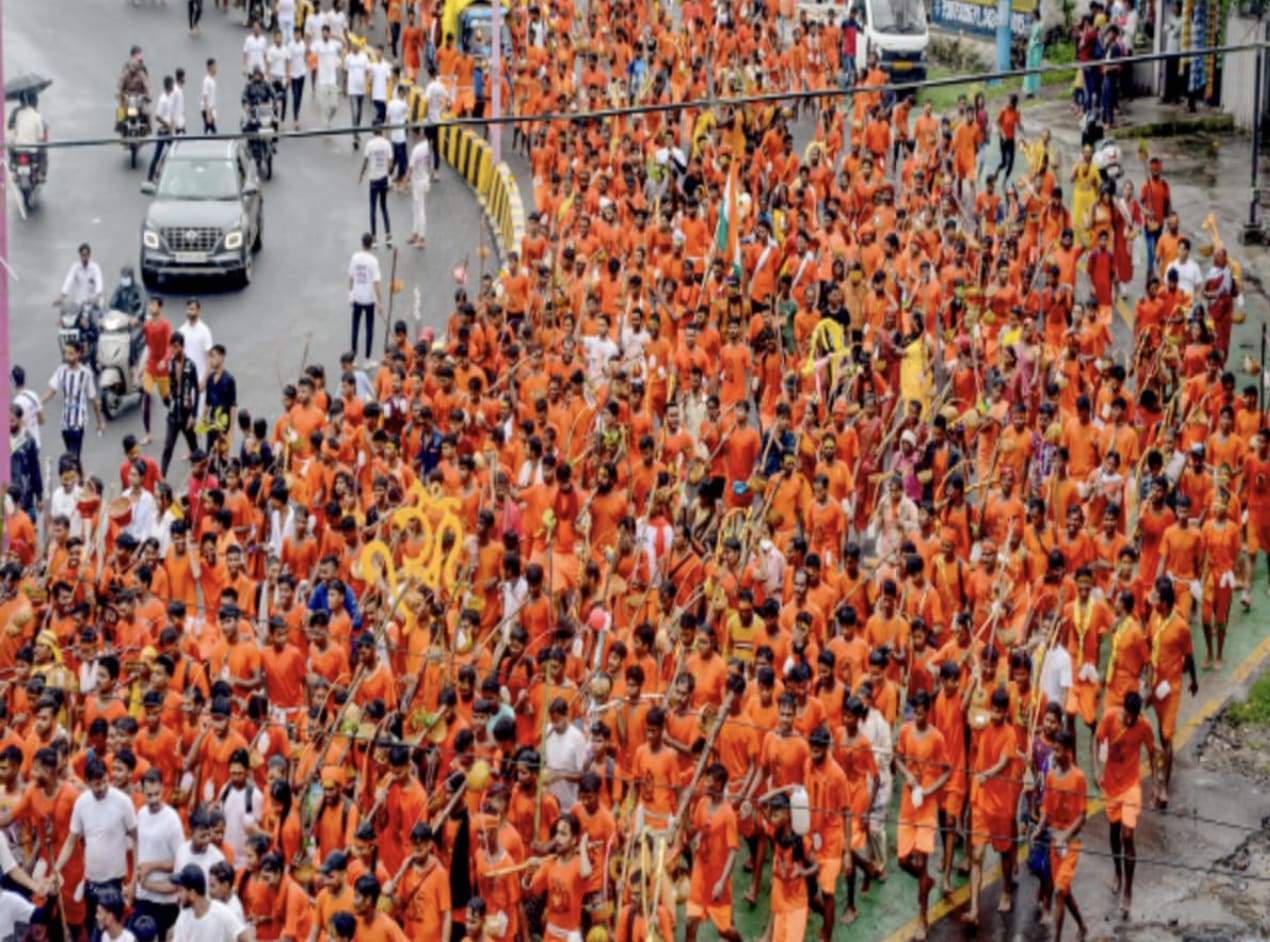
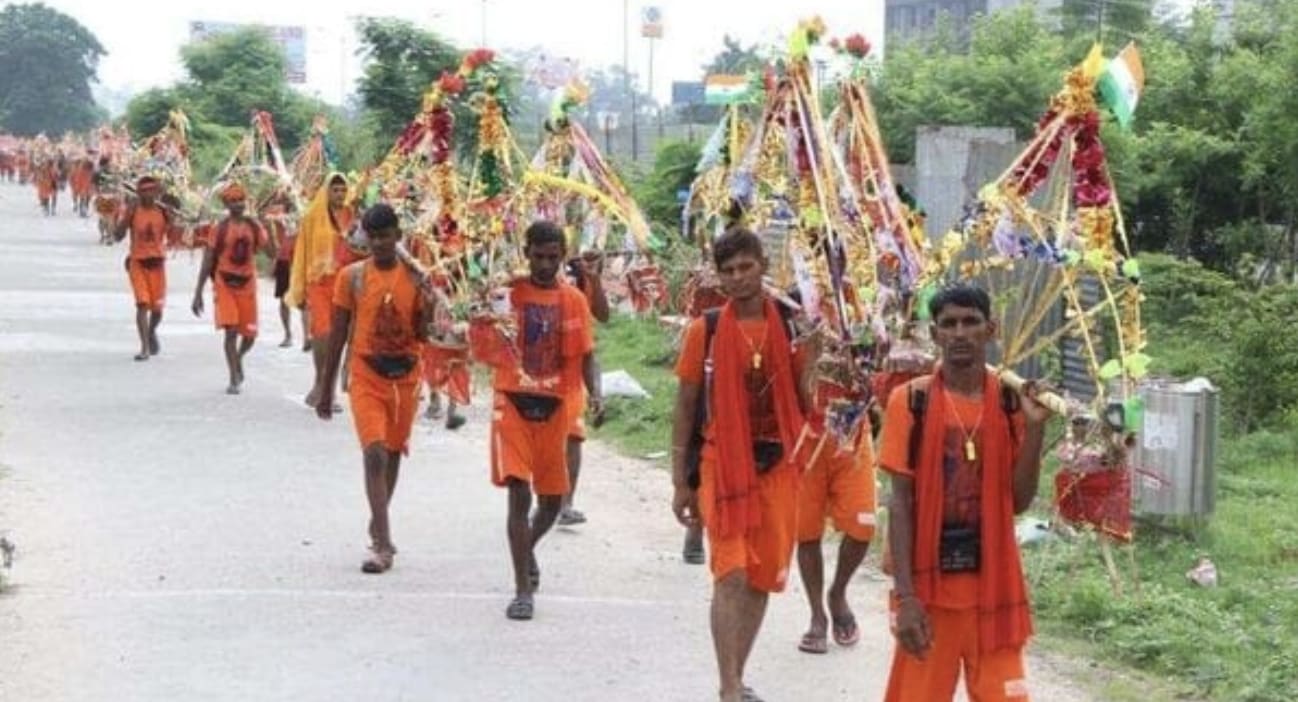
A tide of saffron begins to appear. Not on posters or billboards, but on foot. Young men, barefoot or in plastic slippers, carrying bamboo slings called kanwars, walk for hundreds of kilometers to collect Ganga water from Haridwar, Gaumukh, or Gangotri. Then they carry it back, often on foot again, to offer it to Shiva in a local temple.
For a few weeks, the roads belong to them. The Kanwar Yatra has begun.
And the cities panic.
Pic courtesy: Hindustan
A Sacred Disruption
In cities like Delhi, Noida, Meerut, and Ghaziabad, the Kanwar Yatra isn’t just a religious event. It’s a civic reckoning.
Highways are partially closed. Flyovers are sealed. Police deploy barricades. Drone cameras hover overhead. Loudspeakers blare devotional remixes till late into the night. Civic authorities scramble to respond. Ambulances are rerouted. And residents complain.
In WhatsApp groups and newspaper columns, the complaints sound familiar. “Why can’t they take another route?” “Why is this allowed every year?” “What about our freedom of movement?”
But the tension goes beyond traffic. What we’re really seeing is a collision between two versions of India – one on foot, barefoot and devotional, the other behind the wheel, urban and impatient.
The Myth and the March
The Kanwar Yatra has its roots in mythology. According to legend, during the churning of the cosmic ocean (samudra manthan), a deadly poison emerged that threatened to destroy creation. Shiva consumed the poison to save the world. To cool his burning throat, devotees began offering him water from the Ganga.
Over time, this act of cooling became a physical ritual. Devotees now walk, sometimes for days, to fetch Ganga water and offer it in local temples during Shravan, the monsoon month considered sacred to Shiva.
What began as a humble act of devotion has today become a mass event. The yatra has gone from solitary pilgrimage to cultural assertion. Some walk barefoot in silence. Others come with trucks, speakers, and power generators. The sound systems are louder. The groups are bigger. The presence is more visible.
Who Walks? And Why?
Most Kanwariyas are young, male, and from lower-middle or working-class backgrounds. Many are delivery workers, small shopkeepers, or daily wage earners. They take time off during this month – often without pay – to walk for hundreds of kilometers.
“When I walk with the Kanwar, people make way,” says Ramesh, a 23-year-old delivery worker from Ghaziabad. “Even police show respect. Where else do we get that?”
The Yatra is more than devotion. It’s escape, visibility, and a form of temporary power. For those who are otherwise invisible in India’s urban order, the Kanwar Yatra flips the script. It turns the anonymous worker into a public pilgrim.
There is music, food, dancing, and the feeling – just for a moment – of mattering.
Who Gets Disturbed?
If you’re reading this from a gated colony or office block, chances are you’ve experienced the other side.
Traffic snarls. Loudspeakers at 2 a.m. Temporary encampments on sidewalks. Viral videos of Kanwariyas damaging property after being honked at.
Some of the discomfort is legitimate. Some groups do act with entitlement. There is aggression. There is noise. There are moments of real intimidation.
But there’s also something else underneath – a class discomfort. An unease with faith that is public, noisy, and not curated for polite society.
If the same roads were blocked for a city marathon or a wedding procession, would the outrage be the same?
We celebrate faith when it’s quiet, upper-class, or aesthetic. But when it’s loud, masculine, and working-class, we call it a nuisance.
The State’s Selective Embrace
Governments in Uttar Pradesh and Uttarakhand have not just tolerated the Yatra – they’ve embraced it. Entire lanes are reserved for Kanwar traffic. Helicopter showers have been arranged. Police are instructed to provide assistance, not just enforcement.
This selective accommodation raises difficult questions.
The state’s attitude toward public faith is not neutral. It mirrors electoral incentives, dominant narratives, and cultural hierarchies.
Cities Without Imagination
The annual chaos is often blamed on the Yatra itself. But perhaps the real problem is that Indian cities are not built to accommodate ritual.
Urban planning in India is technocratic. It speaks the language of traffic, density, infrastructure, and GDP. It does not have the vocabulary to understand barefoot faith, public procession, or sacred geography.
The Kanwar Yatra is not an anomaly. It’s an annual, predictable event. But every year, the response is reactive. No long-term design. No civic imagination. Just roadblocks and resentment.
What Would a Better City Do?
A better city wouldn’t pretend the Yatra doesn’t exist. It would plan for it, like it plans for Diwali pollution or Republic Day parades.
Design multi-use paths that serve Kanwariyas in monsoon and pedestrians the rest of the year
Set up designated, well-maintained rest areas to prevent road encroachments
Offer real-time traffic communication and route alerts to residents
Invest in community-led codes of conduct for Kanwar groups
Acknowledge public religion as part of the city’s life, not an exception to it
This is not about romanticising chaos. It’s about designing for reality.
The Larger Question
The Kanwar Yatra is not just a religious procession. It’s a mirror.
It reflects who gets to claim space. Who feels powerful. Whose faith is visible. Whose inconvenience matters.
It also reminds us – sharply – that Indian cities are not neutral. They are contested. They are layered. And sometimes, they are deeply unequal in how they respond to the sacred.
The Road is the Message
Every monsoon, the Kanwariyas walk. The roads belong to them. The cities complain. The media debates. And the tension loops again.
But maybe the real question isn’t about roads or traffic or noise.
Maybe it’s this – what kind of city do we want to live in?
One that is designed only for the efficient? Or one that can hold, however uncomfortably, the full complexity of belief, class, movement, and meaning?
Because if the road cannot hold the pilgrim, it isn’t truly public.
And if we cannot make space for faith, then what are we building – and for whom?